Noratus Cemetery
Field of nearly a thousand medieval khachkars
- Area Gegharkunik
- Type Historic site
- Time needed 45m
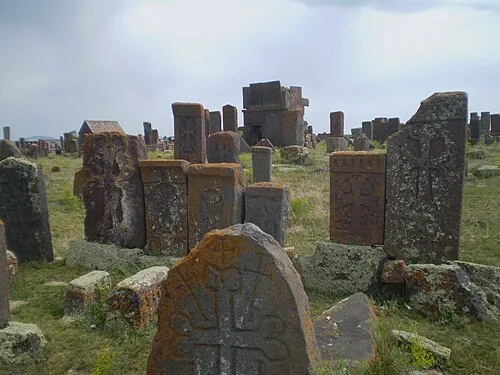
A field of nearly a thousand khachkars, Armenian carved cross-stones, spread across open ground near the Sevan shore. It is the largest surviving khachkar cemetery in the country and the clearest place to see how the form changed over several medieval centuries.
Open in the planner →Getting there
About 85 km from Yerevan, roughly 1h 33m by car, reached by a short turn off the lake road near Gavar. You park at the edge of the field and walk in.
What you see
Rows and clusters of upright stones, from plain early slabs to dense lacework carving on the later ones, many leaning or sunk into the turf. Some carry scenes rather than ornament: a wedding, a funeral feast, figures with animals. A small church and a few burial vaults stand among them.
What to pair it with
Combines well with Hayravank just along the shore, and with a swim or a fish lunch stop on Lake Sevan.
When to go
Morning or late afternoon, when low light picks out the shallow carving. Midday sun flattens the stones, and the field is fully exposed in both heat and wind.
What is hard about it
It is an open field with no shade, no interpretation boards and no facilities. Without some idea of what you are looking at, a thousand grey stones can start to look alike after fifteen minutes.
Common questions
What is a khachkar?
A carved upright stone with a cross as its central motif, used as a memorial or votive marker. The carving around the cross is where the local and period styles show.
Is there a guide on site?
Local women sometimes offer informal guiding or sell knitted goods at the entrance. Nothing is formally arranged. [VERIFY — confirm current details]
How much time is enough?
Three quarters of an hour lets you walk the whole field and look properly at the better-carved stones.
Nearby
- SevanavankPeninsula monastery above the largest lake in the Caucasus
- Lake SevanVast high-altitude lake, beaches and fish restaurants
- HayravankLakeside monastery on a rocky outcrop
- Vanevan Monastery10th-century church near the lake's southern shore
- Makenyats MonasteryMedieval monastery above the village of Makenis
More of the same kind
- Garni TempleFirst-century Hellenistic temple above the Azat gorge
- PtghnavankRoofless 7th-century basilica above the Kasakh
- Zvartnots Cathedral ruinsRuins of a 7th-century circular cathedral
- MetsamorBronze Age metallurgy site and museum